



Explore Kourion Cyprus and Apollon Hylates
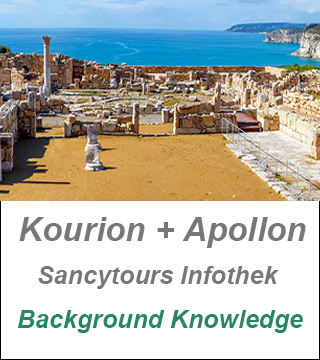 Apollon Hylates Cyprus and Kourion Cyprus are among the island’s most compelling archaeological sites, showcasing the religious devotion, urban sophistication, and architectural legacy of ancient Cypriot civilizations. Set amid the stunning landscapes near the modern city of Limassol, these two sites reveal the cultural and spiritual heart of Cyprus from the Archaic period through Roman times.
In this Sanyctours Infothek entry, we explore the history, function, and fate of both the sanctuary of Apollon Hylates and the city of Kourion—two places where myth meets reality and ancient stone whispers the stories of empires, faith, and resilience.
Kourion – The Ancient City, Theatre and Roman Heritage of Cyprus
Perched high on dramatic limestone cliffs overlooking the Mediterranean Sea, Kourion is one of the most important and impressive archaeological sites in Cyprus. Combining breathtaking coastal scenery with remarkably preserved ancient monuments, Kourion offers visitors a unique opportunity to explore more than two thousand years of history. From magnificent Roman buildings and early Christian churches to spectacular mosaics and one of the finest ancient theatres in the Mediterranean, Kourion provides a fascinating insight into the civilizations that once flourished on the island.
The history of Kourion dates back to the Late Bronze Age, with archaeological evidence suggesting settlement in the area as early as the 13th century BC. According to ancient tradition, Kourion was founded by Greek settlers from Argos following the Trojan War. Thanks to its strategic location overlooking the southern coastline, Kourion developed into one of the most prosperous city-kingdoms of ancient Cyprus. Over the centuries, the city flourished under Greek, Hellenistic, Roman, and Byzantine rule, becoming an important centre of trade, administration, and culture.
Today, visitors arriving at Kourion are immediately impressed by the site’s spectacular setting. Standing on the edge of the cliffs, it is easy to understand why the city’s founders chose this location. The panoramic views across the Mediterranean Sea are among the most beautiful found anywhere in Cyprus and provide a stunning backdrop to the ancient ruins.
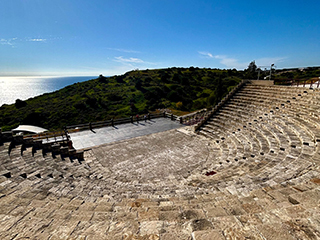
The most famous monument in Kourion is undoubtedly the magnificent Greco-Roman theatre. Originally constructed during the Hellenistic period in the 2nd century BC and later enlarged by the Romans, the theatre once accommodated thousands of spectators. It hosted dramatic performances, musical events, religious celebrations, and public gatherings that formed an essential part of life in Kourion. Carefully restored during the twentieth century, the theatre remains one of the best-preserved ancient structures on the island and is still used today for concerts and cultural performances. Sitting in the ancient stone seats while overlooking the sea is one of the most memorable experiences visitors can enjoy at Kourion.
Another highlight of Kourion is the House of Eustolios, one of the most important residential complexes discovered at the site. Built during the late Roman and early Byzantine periods, the building functioned both as a luxurious residence and as a public guest facility. It is particularly famous for its beautifully preserved mosaic floors, which feature intricate geometric patterns, inscriptions, and decorative motifs. These mosaics provide valuable insight into the wealth, artistic achievements, and daily life of the inhabitants of Kourion during Late Antiquity.
Adjacent to the House of Eustolios are the impressive Roman baths. Like many prosperous Roman cities, Kourion possessed an advanced bathing complex that served not only hygienic purposes but also acted as an important social centre. Visitors can still see the remains of heated rooms, bathing chambers, and sophisticated engineering systems that demonstrate the high level of urban development achieved in Kourion during Roman times.
The heart of public life in Kourion was the Agora, the city’s central marketplace and gathering place. Surrounded by administrative buildings and commercial premises, the Agora was where merchants traded goods, officials conducted public business, and residents met to discuss daily affairs. Walking through the remains of the Agora allows visitors to imagine the vibrant atmosphere that once characterized this thriving ancient city.
As Christianity spread across Cyprus, Kourion became an important religious centre. Following the devastating earthquakes of the 4th century AD, parts of the city were rebuilt and transformed during the Byzantine era. Among the most impressive remains from this period are the ruins of the early Christian basilica, which once served as an important place of worship for the local community. Visitors can still admire sections of the original stone walls, elegant arches, and architectural remains that illustrate the growing importance of Christianity in Kourion. These atmospheric ruins are among the most photogenic parts of the archaeological site and provide a fascinating glimpse into the city’s transition from the Roman world to the Byzantine Christian era.
Another fascinating building within Kourion is the House of the Gladiators, named after its remarkable mosaic depicting scenes of gladiatorial combat. The artwork is among the finest Roman mosaics discovered in Cyprus and reflects the popularity of Roman entertainment throughout the empire. Such discoveries help historians better understand how the people of Kourion lived, worked, and spent their leisure time nearly two thousand years ago.
One of the lesser-known but equally important aspects of Kourion was its sophisticated water management system. The city was supplied through aqueducts, reservoirs, fountains, and public water facilities that supported a growing urban population. These engineering achievements demonstrate the advanced planning and technical knowledge that helped Kourion flourish for centuries.
Like many ancient cities in the Eastern Mediterranean, Kourion suffered significant damage during a series of powerful earthquakes in the 4th century AD. Although parts of the city were rebuilt, its importance gradually declined over time. Eventually, the settlement was abandoned, leaving behind the remarkable remains that visitors can explore today. Archaeological excavations have revealed layer upon layer of history, making Kourion one of the most significant historical sites on the island.
Sanctuary of Apollo Hylates – The Sacred Centre of Ancient Cyprus
The Sanctuary of Apollo Hylates is one of the most important religious and archaeological sites in Cyprus. Located near Kourion on the island’s southern coast, the sanctuary served as a major centre of worship for more than a thousand years. Dedicated to Apollo Hylates, the protector of woodlands, wildlife, and nature, the site attracted pilgrims from across ancient Cyprus and the wider Mediterranean world.
Today, the Sanctuary of Apollo Hylates offers visitors a fascinating journey into the spiritual life of the ancient world. Surrounded by beautiful Mediterranean landscapes, the sanctuary combines impressive ruins, rich history, and a peaceful atmosphere that reflects its former importance as one of the island’s most revered sacred places.
The earliest evidence of worship at the Sanctuary of Apollo Hylates dates back to the 8th century BC, although the site continued to develop and expand throughout the Hellenistic and Roman periods. For centuries, pilgrims travelled to the sanctuary to honour Apollo, seek blessings, make offerings, and participate in religious festivals. The sanctuary remained active until the 4th century AD, when the spread of Christianity gradually brought an end to the ancient pagan cults of Cyprus.
Apollo was one of the most important gods in the Greek world, associated with light, music, healing, prophecy, and protection. In Cyprus, he was worshipped under the name Apollo Hylates, meaning “Apollo of the Forest” or “Apollo of the Woodland.” This unique local form of Apollo reflects the strong connection between the sanctuary and the surrounding natural environment.
Visitors entering the Sanctuary of Apollo Hylates today pass through the remains of what was once an impressive religious complex. The site underwent several phases of construction over the centuries, with many of the visible remains dating from the Roman period. Archaeological excavations have revealed temples, ceremonial courtyards, public buildings, accommodation for pilgrims, and impressive architectural features that demonstrate the sanctuary’s importance.
At the heart of the complex stands the reconstructed section of the Temple of Apollo. Although only a portion of the original structure survives, the remaining columns provide an impressive impression of the temple’s former grandeur. This sacred building housed the cult of Apollo Hylates and served as the focal point for religious ceremonies and offerings. Standing among the columns, visitors can easily imagine the thousands of worshippers who once gathered here to honour the god.
One of the most striking features of the Sanctuary of Apollo Hylates is its large ceremonial courtyard. This open area was used for religious processions, festivals, and public gatherings associated with the worship of Apollo. During major celebrations, pilgrims would travel from surrounding regions to participate in rituals and ceremonies held within the sanctuary.
The site also contains the remains of a palaestra, an ancient training ground where athletic activities and competitions were held. Physical exercise formed an important part of Greek culture, and religious festivals often included sporting events alongside ceremonial celebrations. The presence of the palaestra demonstrates that the Sanctuary of Apollo Hylates served not only as a religious centre but also as a place of social and cultural interaction.
Another important feature is the ancient bath complex, which reflects the influence of Roman architecture and engineering. Pilgrims and visitors could use these facilities as part of their visit to the sanctuary. The baths illustrate how the site continued to evolve and expand during Roman rule, adapting to changing architectural styles and visitor needs.
Archaeologists have also uncovered residential buildings, storage areas, and administrative structures that supported the daily operation of the sanctuary. Priests, temple staff, and workers would have managed religious ceremonies, maintained the buildings, and cared for the many visitors arriving throughout the year.
The Sanctuary of Apollo Hylates suffered damage from several earthquakes during its long history, including major seismic events that affected much of Cyprus. Although repairs and rebuilding took place on multiple occasions, the sanctuary eventually declined as Christianity spread across the island. By the end of the 4th century AD, worship at the sanctuary had largely ceased, marking the end of one of Cyprus’ longest-running religious traditions.



Explore Kourion with SancyTours
Kourion and the Sanctuary of Apollo Hylates can be explored with SancyTours as a private and individual experience, allowing you to discover these remarkable ancient sites in a calm and immersive way. Our guided visits focus on context, history and understanding, giving you the time and space to experience Kourion and its sacred landscapes beyond surface impressions.
Choose your date and book now:
| M | T | W | T | F | S | S | |
|---|---|---|---|---|---|---|---|
36 | 1 | 2 | 3 | 4 | 5 | 6 | |
37 | 7 | 8 | 9 | 10 | 11 | 12 | 13 |
38 | 14 | 15 | 16 | 17 | 18 | 19 | 20 |
39 | 21 | 22 | 23 | 24 | 25 | 26 | 27 |
40 | 28 | 29 | 30 |
| M | T | W | T | F | S | S | |
|---|---|---|---|---|---|---|---|
40 | 1 | 2 | 3 | 4 | |||
41 | 5 | 6 | 7 | 8 | 9 | 10 | 11 |
42 | 12 | 13 | 14 | 15 | 16 | 17 | 18 |
43 | 19 | 20 | 21 | 22 | 23 | 24 | 25 |
44 | 26 | 27 | 28 | 29 | 30 | 31 |
Author: Jürgen Derichs am 7. May 2025 10:30, category: Infothek – Historical Sites, comments per feed RSS 2.0, comments closed.