



The Ottoman Conquest of Famagusta and Its Legendary Fortifications
 Famagusta Cyprus stands as a testament to the island’s rich and tumultuous history, with its impressive city walls and formidable fortresses bearing witness to centuries of conflict and cultural exchange.
From the medieval grandeur of the Lusignan period to the strategic enhancements under Venetian rule, and the dramatic events of the Ottoman conquest, Famagusta offers a captivating journey through time. In this Sanyctours Infothek entry, we delve into the origins, architectural marvels, and historical significance of Famagusta, providing a comprehensive understanding of its enduring legacy.
The Ottoman Conquest of Famagusta (1570–1571)
The Ottoman conquest of Famagusta ranks among the most dramatic and significant events in the history of Cyprus. In 1570, Sultan Selim II launched a major campaign to wrest control of the island from the Republic of Venice. Within a short period, most of Cyprus had fallen to the advancing Ottoman forces. Only Famagusta, protected by some of the strongest fortifications in the Mediterranean, remained under Venetian control.
As the Ottoman army advanced across the island, thousands of refugees fled to Famagusta seeking protection behind its massive walls. In addition to the Venetian garrison, the city sheltered civilians, merchants, craftsmen, clergy, women, and children. By the time the siege began, an estimated 15,000 to 20,000 people were living within the fortified city.
Under the command of the Venetian governor Marco Antonio Bragadin, the defenders resisted a vastly superior Ottoman force. For almost eleven months, the city endured relentless artillery bombardment, repeated assaults, food shortages, disease, and destruction. Despite these hardships, both soldiers and civilians contributed to the defence of Famagusta, repairing damaged walls, transporting supplies, caring for the wounded, and helping maintain the city’s resistance.
The extraordinary strength of Famagusta’s fortifications allowed the defenders to hold out far longer than expected. However, by August 1571, ammunition and supplies were nearly exhausted, and the city was no longer able to continue the fight. The Venetians agreed to surrender under terms that promised safe passage for the surviving defenders and civilians.
Following the capitulation, relations between the two sides quickly deteriorated. Governor Marco Antonio Bragadin was arrested, tortured, and eventually executed in one of the most infamous episodes of the Ottoman-Venetian wars. Many soldiers and civilians were taken prisoner, while others were enslaved or forced to begin a new life under Ottoman rule.
With the fall of Famagusta, Venetian rule on Cyprus came to an end. The island became part of the Ottoman Empire and remained under Ottoman administration for more than three centuries.
Othello Castle – Guardian of Famagusta Harbour
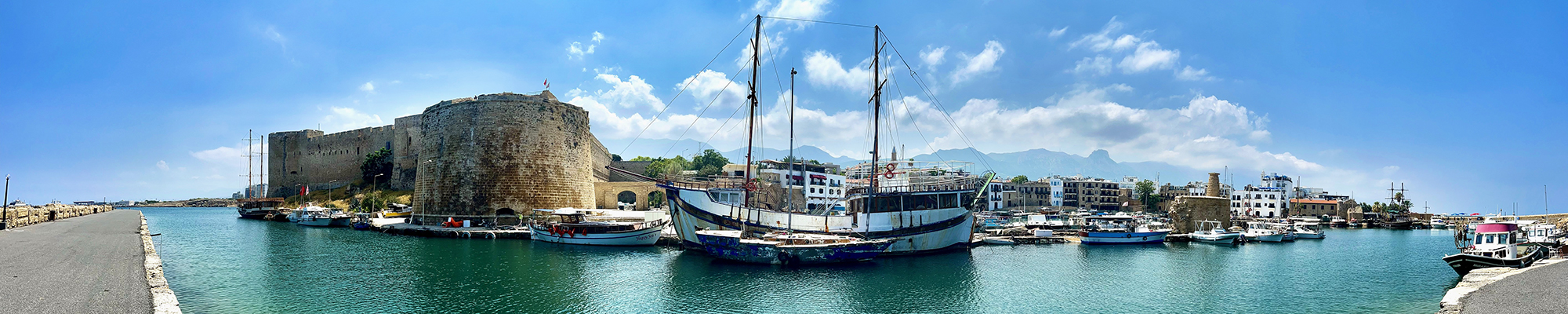
The famous Othello Castle stands at the entrance to Famagusta’s historic harbour and served as the city’s first line of defence against attacks from the sea. Originally constructed by the Lusignan dynasty during the 14th century, the fortress protected one of the busiest and wealthiest trading ports in the Eastern Mediterranean.
As Famagusta grew into a major commercial centre, merchants from across Europe and the Middle East passed through its harbour. Protecting this maritime gateway became essential, and Othello Castle evolved into a formidable coastal fortress.
When Venice assumed control of Cyprus in 1489, the castle was modernised to withstand artillery attacks. The Venetians replaced vulnerable square towers with powerful circular bastions and reinforced the walls to meet the challenges of Renaissance warfare. Above the entrance, visitors can still see the Lion of Saint Mark, the enduring symbol of Venetian power.
The castle later became associated with William Shakespeare’s tragedy Othello. Although no historical connection exists between the fortress and the events of the play, local tradition linked the castle with Shakespeare’s famous character, giving the fortress its modern name.
During the Ottoman siege, Othello Castle formed an important component of Famagusta’s harbour defences and played a crucial role in protecting the city from naval attack.
The Ravelin Bastion – Key to the Land Defences
The Ravelin Bastion was one of the most heavily fortified positions within the defensive system of Famagusta. Built and expanded during the Venetian period, it was designed specifically to counter the growing threat posed by artillery warfare.
Located in front of the Land Gate, the principal entrance to the city from inland Cyprus, the Ravelin served as a protective shield for one of the most vulnerable sections of the fortifications. Any attacking army attempting to enter Famagusta from the landward side had to overcome this powerful defensive structure before reaching the main city walls.
The bastion featured massive earth-filled walls capable of absorbing cannon fire far more effectively than traditional medieval fortifications. Its strategic design allowed defenders to maintain overlapping fields of fire, making direct assaults extremely costly.
During the Ottoman siege, the Ravelin Bastion became the scene of some of the fiercest fighting. Repeated Ottoman attacks were launched against this critical position, and the defenders fought desperately to hold it. The bastion’s advanced design played a major role in prolonging the defence of the city and demonstrated the effectiveness of Venetian military engineering.
Martinengo Bastion – The Masterpiece of Renaissance Military Architecture
Among all the fortifications of Famagusta, the Martinengo Bastion is widely regarded as the most advanced military structure ever constructed on Cyprus. Built between approximately 1550 and 1559, it represented the cutting edge of Renaissance fortress design.
Unlike traditional medieval towers, the Martinengo Bastion featured low, thick walls filled with earth and rubble, allowing them to absorb the impact of artillery fire. Its distinctive arrowhead shape eliminated blind spots and enabled defenders to fire upon attackers from multiple directions simultaneously.
One of its most innovative features was the ability to provide flanking fire along adjacent sections of the city walls. This dramatically increased the effectiveness of the city’s defence and made large-scale assaults far more difficult.
Military historians often consider the Martinengo Bastion one of the finest surviving examples of Venetian military engineering anywhere in the Mediterranean. During the Ottoman siege, it proved remarkably resilient, helping the defenders withstand months of bombardment and repeated attacks.
Today, the Martinengo Bastion remains an impressive testament to the ingenuity of Renaissance military architects and the strategic importance of Famagusta during the struggle between Venice and the Ottoman Empire.
Epilogue – The Legacy of Famagusta’s Fortifications
The fortifications of Famagusta represent far more than walls, towers, and bastions. They tell the story of one of the most dramatic sieges of the Renaissance and of a city that stood at the crossroads of Europe, Asia, and the Middle East.
For almost eleven months, soldiers and civilians defended Famagusta against overwhelming odds. Thousands of people lived within the city walls during the siege, enduring hunger, disease, destruction, and constant artillery fire. Their determination transformed Famagusta into a symbol of resistance throughout Europe.
The combined strength of Othello Castle, the Ravelin Bastion, and the Martinengo Bastion made Famagusta one of the strongest fortified cities in the Mediterranean. These structures reflected the evolution of military architecture from medieval fortresses to the sophisticated artillery defences of the Renaissance.
Although the city ultimately fell to the Ottomans in 1571, its fortifications survived. More than four centuries later, visitors can still walk along the same walls, stand atop the same bastions, and admire the same harbour that once witnessed one of the greatest military confrontations in Cypriot history.
Today, the fortifications of Famagusta remain among the most important historical monuments in Cyprus, preserving the legacy of Venetians, Ottomans, merchants, soldiers, and ordinary citizens whose lives were forever shaped by the events of 1570–1571.
Discover the Historic Fortifications of Famagusta with SancyTours
The impressive fortifications and castles of Famagusta are best explored on a private tour with SancyTours. Accompanied by your personal guide, you can discover the city’s remarkable defensive walls, historic gates, towers, and medieval military architecture at your own pace, without the stress and time constraints of large group excursions. Learn how Venetians, Ottomans, and other rulers transformed Famagusta into one of the strongest fortified cities in the Mediterranean.
A visit to the historic fortifications of Famagusta can be perfectly combined with the nearby ancient city of Salamis, where magnificent Roman ruins, baths, columns, and the famous amphitheatre bring the ancient world back to life. Alternatively, history enthusiasts may wish to include a visit to the world-famous Varosha Ghost Town, offering a unique and thought-provoking insight into the events of 1974 and their lasting impact on Cyprus.
Combining Famagusta, Salamis, and Varosha creates one of the most diverse and fascinating sightseeing experiences on the island, linking ancient civilizations, medieval history, and modern events within a single unforgettable day.
With SancyTours, every tour is individually tailored to your interests, ensuring a relaxed, informative, and memorable journey through the rich heritage of Northern Cyprus.
Author: Jürgen Derichs am 7. May 2025 10:16, category: Infothek – Historical Sites, comments per feed RSS 2.0, comments closed.