



Why Cyprus Is Divided – Two Regions, One Island
 Understanding why Cyprus is divided is essential for anyone who wants to truly know the island beyond its beaches and resorts. Today, Cyprus exists as two separate regions — the Republic of Cyprus in the south and Northern Cyprus in the north — divided by a UN-controlled buffer zone that cuts across the island.
The roots of why Cyprus is divided stretch back to colonial times. For nearly a century, Cyprus was administered by Great Britain. During this period, nationalist movements began to grow among Greek Cypriots who wished to unite with Greece, while Turkish Cypriots feared becoming a minority and favored either British protection or partition.
In 1960, Cyprus gained independence from Great Britain and became the Republic of Cyprus. The new state was designed to be shared by both Greek and Turkish communities, with a complex power-sharing system. However, disagreements and mistrust soon led to violence during the 1960s, prompting the United Nations to send peacekeeping forces to the island — forces that still operate today.
United Nations peacekeepers were first deployed in Cyprus in 1964 to help control intercommunal violence. After the Turkish invasion in 1974, the UN expanded its presence and officially established the Buffer Zone, also known as the Green Line, which continues to divide the island today.
The key event explaining why Cyprus is divided occurred in 1974. A coup supported by the Greek military government aimed to overthrow the Cypriot leadership and unite the island with Greece. In response, Turkey launched a military intervention, citing the protection of Turkish Cypriots as justification.
Turkish forces took control of roughly one-third of the island in the north.
This resulted in mass displacement: Greek Cypriots fled south, while Turkish Cypriots moved north. Entire communities were abandoned, and Cyprus became physically split.
Since then, the UN Buffer Zone — often called the Green Line — has separated the two sides. This zone passes through towns, countryside, and even the capital city of Nicosia, making it the last divided capital in Europe.
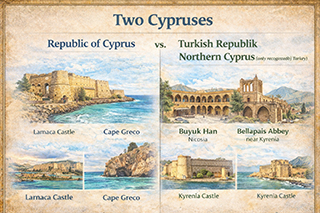
In 1983, the northern part declared itself the Turkish Republic of Northern Cyprus. However, this entity is recognized only by Turkey. No other country officially accepts Northern Cyprus as an independent state, and it remains politically and economically dependent on Turkey.
This international non-recognition is a major reason why Cyprus is divided remains an unresolved issue.
UN peacekeepers continue to patrol the buffer zone, maintaining stability and preventing further conflict. Special locations such as Pyla exist within the buffer zone, where Greek Cypriots and Turkish Cypriots live together under UN supervision.
Although border crossings opened in 2003, allowing movement between north and south, Cyprus remains politically divided.
Today, visitors can experience both sides of the island — each reflecting different cultural influences. The south is European in character, while the north shows strong Turkish traditions in food, language, and architecture.
Learning why Cyprus is divided helps explain many of the island’s abandoned places, military zones, and political realities still visible today. It is a story of colonial legacy, nationalism, conflict, displacement, and ongoing efforts for peace.
Why Cyprus Is Divided
Another important aspect of why Cyprus is divided today is the economic development of both regions. Since the division of Cyprus in 1974, the Republic of Cyprus in the south has become a member of the European Union and developed into a modern economy based on tourism, services, shipping, and international business. In contrast, Northern Cyprus has remained largely isolated due to its lack of international recognition. This separation strongly influences daily life and explains many differences visitors notice when exploring why Cyprus is divided between north and south.
The economic situation in Northern Cyprus is closely linked to Turkey, which provides financial support and infrastructure investments. One noticeable difference for travelers is that Northern Cyprus does not apply VAT (Value Added Tax) in the same way as the Republic of Cyprus. This means many products such as clothing, electronics, souvenirs, and everyday goods are often significantly cheaper in the north. For visitors learning why Cyprus is divided, this economic contrast is a clear example of how the island’s political situation affects prices, development, and lifestyle on both sides of the Green Line.
When people explore why Cyprus is divided, they quickly notice how different infrastructure and development appear on each side of the island. In the south, modern highways, international hotels, and large business centers reflect decades of investment and EU funding. In Northern Cyprus, many areas still show a slower pace of development, although recent years have brought growing foreign investment, especially in real estate and tourism projects along the northern coastline. This contrast is another direct result of why Cyprus is divided politically and economically.
Understanding why Cyprus is divided also helps explain the different legal systems, currencies, and trade structures that exist today. While the Republic of Cyprus uses the euro and follows European Union regulations, Northern Cyprus uses the Turkish lira and operates under Turkish economic influence. These differences affect everything from property ownership to salaries and consumer prices. For visitors, learning why Cyprus is divided offers valuable insight into how history continues to shape everyday life across the island.
Looking ahead, many experts believe that resolving why Cyprus is divided will remain a long-term challenge. Despite ongoing negotiations supported by the United Nations and the European Union, a full reunification of the island and the withdrawal of Turkish troops from Northern Cyprus may still take decades. Political interests, security concerns, and unresolved property claims continue to slow progress. While hope remains for a peaceful solution, the reality of why Cyprus is divided shows that healing historical divisions requires time, trust, and sustained international cooperation.
To fully understand why Cyprus is divided, it is important to look not only at history but also at everyday life on both sides of the island today. Why Cyprus is divided continues to shape politics, education, media, and even family connections across the Green Line. Many Cypriots on both sides were born after the events of 1974, yet the reality of why Cyprus is divided remains part of daily conversation and identity. Schools teach different historical perspectives, and economic systems have developed separately, reinforcing why Cyprus is divided not only geographically but socially as well. Even simple activities such as crossing from south to north highlight why Cyprus is divided in practical terms, with checkpoints, documentation, and different regulations.
Why Cyprus is divided is not only a political question but also a reality that affects tourism, travel, and daily movement across the island. Visitors quickly notice why Cyprus is divided when crossing the Green Line between the Republic of Cyprus and Northern Cyprus. Different currencies, legal systems, and administrative structures clearly show why Cyprus is divided in practice. While the southern part operates as a member of the European Union, the northern part functions under Turkish administration, further reinforcing why Cyprus is divided economically and politically. This situation influences everything from business investments to infrastructure development.
Another important aspect of why Cyprus is divided lies in the ongoing diplomatic efforts for reunification. Over the decades, numerous peace talks have taken place under United Nations supervision, all aiming to resolve why Cyprus is divided and find a lasting solution. Although progress has been made at times, deep-rooted political disagreements and security concerns have repeatedly slowed negotiations. Many experts believe that overcoming why Cyprus is divided will require long-term trust-building, economic cooperation, and gradual demilitarization of the northern region. For now, why Cyprus is divided remains one of the most complex unresolved conflicts in Europe.
Author: Jürgen Derichs am 27. Jan. 2026 14:49, category: Good to know about Cyprus, comments per feed RSS 2.0, comments closed.