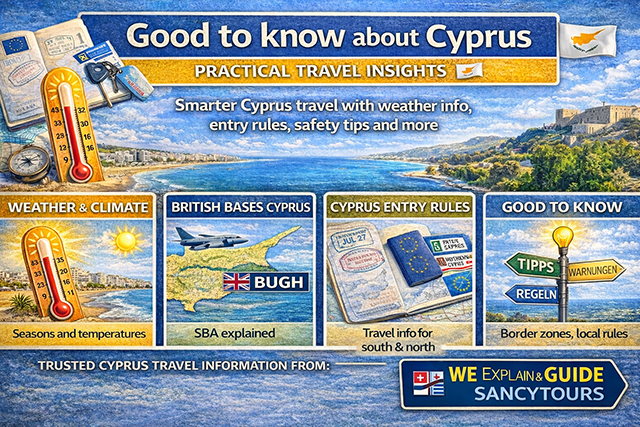
 Cyprus is one of the most rewarding travel destinations in the Mediterranean — but it also has its own special rules, unique geography and historical realities that can surprise first-time visitors. That’s why we created Good to know about Cyprus: a practical knowledge area designed for travellers who want clarity, confidence, and fewer question marks during their stay.
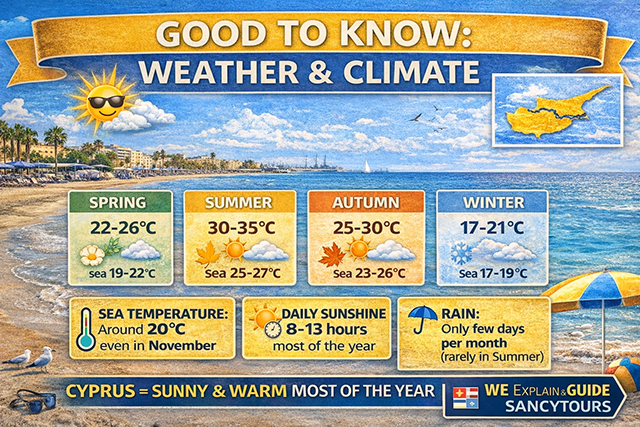
In Good to know about Cyprus, we share travel insights that go beyond sightseeing. Here you’ll learn about the climate in Cyprus and what it really means for your holiday planning — including the best seasons to visit, what temperatures you can expect in the Larnaca region, and how warm the sea is throughout the year. Understanding these details makes it much easier to choose the right travel period — whether you come for nature tours, historic explorations, or diving adventures.
But Good to know about Cyprus is not only about weather. Cyprus is still politically divided, and many travellers have questions about the Green Line, the UN Buffer Zone, and what happens when crossing from south to north (or back again). We explain these topics in a clear and traveller-friendly way — including special areas such as Varosha, Pyla, and the British Sovereign Base Areas (SBA), where different rules apply and where even unusual border crossings can exist.
The goal of Good to know about Cyprus is simple: to help you travel smarter. No confusion. No stress. No unpleasant surprises — just the confidence of knowing what matters before you go.
And of course, if you don’t want to worry about logistics at all: many of these topics become effortless when you travel with us. With Sancytours private tours, you explore Cyprus safely, comfortably, and with local guidance — while we take care of the details in the background.
Good to know about Cyprus – Travel Tips & Local Insights

more »
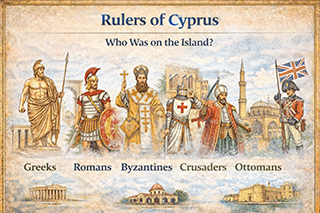
The History of Cyprus begins more than 10,000 years ago, when the first settlers arrived on the island during the Stone Age. Archaeological findings show early farming communities, simple houses, and tools made of stone.
These first inhabitants laid the foundation for the long and complex History of Cyprus as a meeting point of cultures.
more »
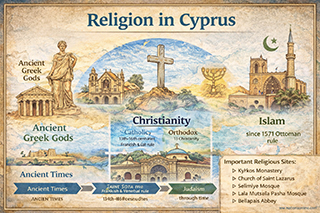
Religion in Cyprus has evolved over thousands of years, shaped by empires, cultures, and major historical turning points. From the worship of ancient gods to the rise of Christianity, the influence of Judaism, and the arrival of Islam, religion in Cyprus tells the story of the island itself — a crossroads of civilizations in the Eastern Mediterranean.
In ancient times, religion in Cyprus centered around Greek and Phoenician deities. Temples dedicated to Aphrodite, Apollo, and other gods were spread across the island, particularly in places like Paphos and Kourion. These early belief systems were deeply connected to nature, fertility, and the sea, which played a central role in everyday life.
more »
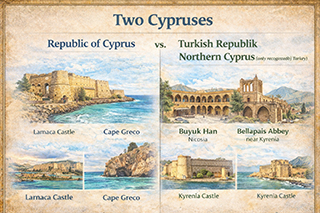
Understanding why Cyprus is divided is essential for anyone who wants to truly know the island beyond its beaches and resorts. Today, Cyprus exists as two separate regions — the Republic of Cyprus in the south and Northern Cyprus in the north — divided by a UN-controlled buffer zone that cuts across the island.
The roots of why Cyprus is divided stretch back to colonial times. For nearly a century, Cyprus was administered by Great Britain. During this period, nationalist movements began to grow among Greek Cypriots who wished to unite with Greece, while Turkish Cypriots feared becoming a minority and favored either British protection or partition.
more »
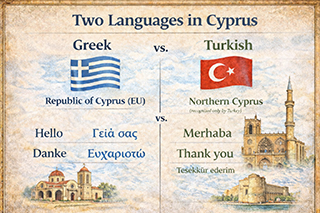
Languages in Cyprus – From Ancient Greek World to Ottoman Rule and Modern Times
The origins of Languages in Cyprus reach far back into the history of the eastern Mediterranean. Long before modern borders existed, Greek culture and language dominated much of the region, including Cyprus.
From around the second millennium BCE, Greek settlers arrived on the island and established city kingdoms such as Salamis, Kition, and Paphos. These cities became part of the wider Greek-speaking Mediterranean world, connected through trade, culture, and religion. For centuries, Greek was the everyday language of Cyprus and the main language of administration, literature, and worship.
more »
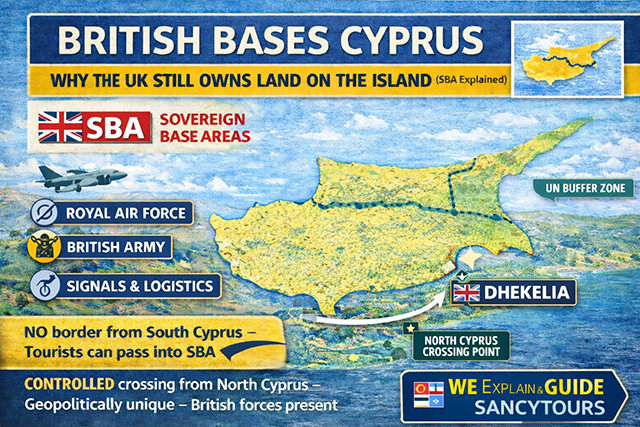
Many travellers are surprised when they learn that Cyprus is not only divided into North and South — but also contains official British territory. The British Bases Cyprus are known as the Sovereign Base Areas (SBA), and they are one of the most unique political and military realities in the entire Mediterranean.
Even though Cyprus became independent in 1960, the UK retained two strategic military zones: Akrotiri (near Limassol) and Dhekelia (near Larnaca). These areas are not “leased” bases — they are legally British land, with their own administration and security.
So why do the British Bases Cyprus exist at all? And what exactly happens there?
more »
The Green Line Cyprus is not just a line on a map — it is one of the most unusual political and geographic realities in Europe. Cutting through landscapes, villages and even the heart of Nicosia, the Green Line Cyprus forms a UN-controlled buffer zone that has separated the island for decades.
For travellers, this division is often surprising: you can stand in a vibrant shopping street and, only a few metres away, see abandoned buildings, barbed wire, warning signs and silent streets that still carry the weight of history.
In this Sancytours Infothek entry, we explain what the Green Line Cyprus really is, how it works, and why certain areas inside the buffer zone — like Varosha and Pyla — are so special.
more »
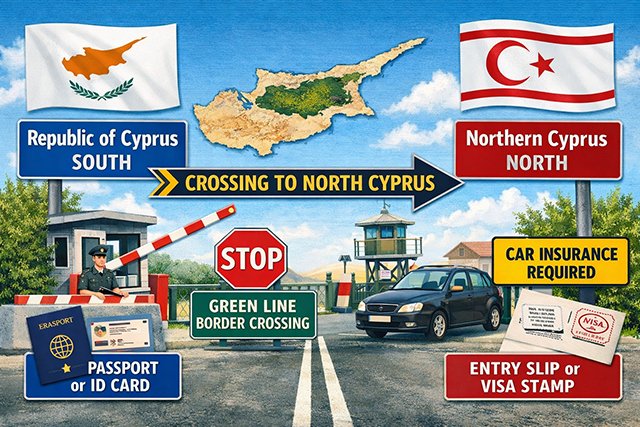
North Cyprus entry requirements are one of the most common questions we receive from guests planning a tour to the northern part of the island. While travelling between south and north Cyprus is usually straightforward, it is still important to understand the basic rules, the documents required, and what happens at the crossings.
This guide explains the most practical points about North Cyprus entry requirements, including the Green Line crossings, passports vs. ID cards, entry stamps, and useful tips for travellers.
more »
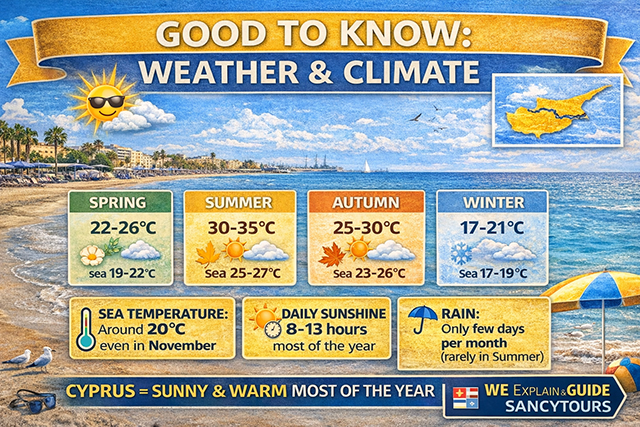 Larnaca Weather – Sunshine, Wind & What It Feels Like in Daily Life. One of the reasons travellers love Larnaca weather is the sheer amount of sunshine. Even outside summer, Larnaca weather often feels bright and pleasant, which makes Cyprus an ideal destination for guests who want to escape grey skies. In spring and autumn, Larnaca weather is especially comfortable — warm in the daytime, refreshing in the evening, and perfect for long walks along the promenade or private sightseeing tours.
more »