






Languages in Cyprus -Why we have two languages
 Languages in Cyprus – From Ancient Greek World to Ottoman Rule and Modern Times
The origins of Languages in Cyprus reach far back into the history of the eastern Mediterranean. Long before modern borders existed, Greek culture and language dominated much of the region, including Cyprus.
From around the second millennium BCE, Greek settlers arrived on the island and established city kingdoms such as Salamis, Kition, and Paphos. These cities became part of the wider Greek-speaking Mediterranean world, connected through trade, culture, and religion. For centuries, Greek was the everyday language of Cyprus and the main language of administration, literature, and worship.
Even when Cyprus became part of large empires such as the Persian, Hellenistic, and Roman worlds, Greek remained the dominant language. In fact, throughout the eastern Mediterranean, Greek functioned as a common language — similar to how English is used internationally today.
During the Byzantine period, Greek language and Orthodox Christian culture became even more deeply rooted in Cyprus. By the Middle Ages, Greek identity and language were firmly established across the island.
A major transformation in Languages in Cyprus occurred in 1571, when the Ottoman Empire conquered Cyprus. With Ottoman rule came Turkish settlers, administrators, and soldiers. Turkish language and Islamic traditions were introduced, adding a new cultural layer to the island.
Over the following centuries, Cyprus developed into a society where Greek-speaking Christian communities and Turkish-speaking Muslim communities lived side by side. Greek continued to be the majority language, while Turkish became the language of the Ottoman authorities and the Muslim population.
This coexistence shaped the bilingual character of Cyprus long before the modern political division.
When the British took control of Cyprus in 1878, English became the language of government and education in many areas. However, Greek and Turkish remained the main spoken languages among the people.
After independence in 1960, both Greek and Turkish were officially recognized as state languages, reflecting the island’s dual cultural heritage.
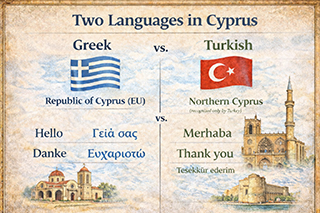
The division of Cyprus in 1974 led to a geographical separation of Languages in Cyprus. Today, Greek is mainly spoken in the Republic of Cyprus in the south, while Turkish is spoken in Northern Cyprus. English continues to be widely used across both sides, especially in tourism and business.
The development of Languages in Cyprus shows how the island has always been a meeting point of civilizations. From ancient Greek influence across the eastern Mediterranean to the arrival of Turkish language and culture during Ottoman rule, Languages in Cyprus evolved through centuries of interaction and coexistence. Understanding Languages in Cyprus helps visitors see why Greek and Turkish are still central to everyday life and identity on the island today.
Languages in Cyprus – today
In modern times, Languages in Cyprus continue to expand beyond Greek and Turkish. In many schools across the island, students now learn additional foreign languages such as English, German, French, and sometimes Russian. Especially English plays an important role in daily communication, tourism, and international business. The growing focus on multilingual education reflects Cyprus’s position as a crossroads between Europe, the Middle East, and the Mediterranean. Today, Languages in Cyprus represent not only ancient traditions but also a modern, open society connected to the wider world.
The topic of Languages in Cyprus is essential for understanding the island’s history and culture. From ancient times until today, Languages in Cyprus have evolved through Greek settlement, Ottoman influence, and modern education. Exploring Languages in Cyprus helps visitors understand daily life in both regions of Cyprus. The development of Languages in Cyprus shows how the island connects different civilizations and traditions. Learning about Languages in Cyprus gives deeper insight into Cyprus’s unique identity.
Author: Jürgen Derichs am 27. Jan 2026 11:06, category: Good to know about Cyprus, comments per feed RSS 2.0, comments closed.