


White Rocks and White Sands – Chalk Ledges and Coastal Coves
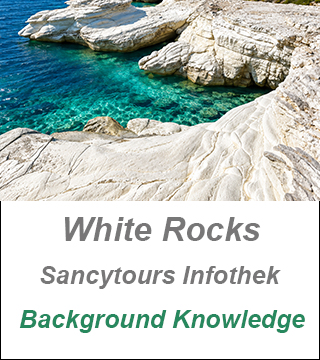 The White Rocks in Cyprus take their name from the chalk that forms this stretch of coast.
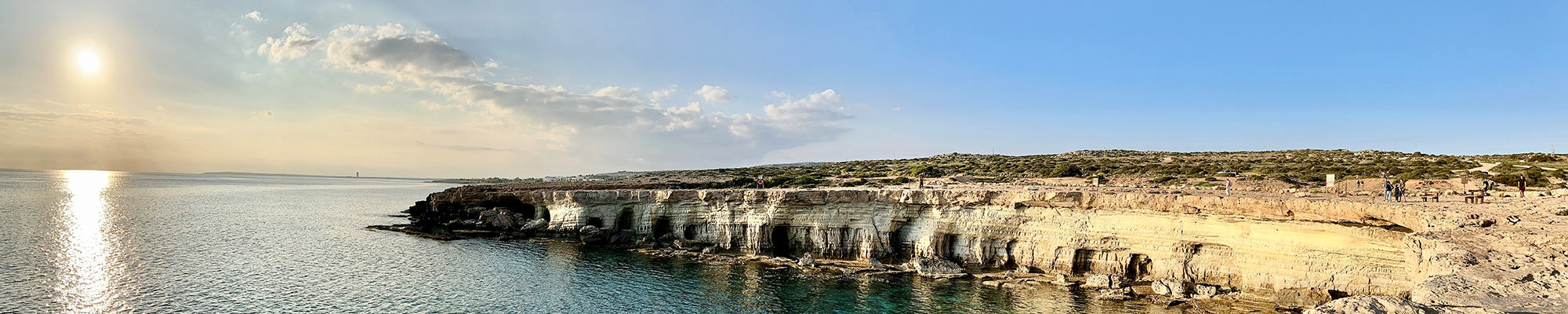
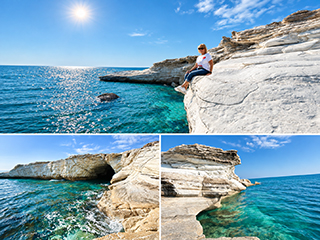
From the shore, you can follow pale layers across the rock faces and see where flat ledges reach into the sea. Between them, the coast breaks into small coves. Some have pebbles, while others have dark grey sand that makes the chalk look even brighter.
Why are the rocks so white, and where should you look if you want a sandy beach?
Where are the White Rocks?
 The White Rocks lie on the south coast of Cyprus, east of Limassol, near Agios Georgios Alamanou. For example, the official Visit Cyprus cycling route lists White Rocks Beach, Agios Georgios Alamanos Beach and Governor’s Beach separately.
If you’re looking for the rocky shoreline on a map, start with White Rocks Beach.
Why are the rocks so white?
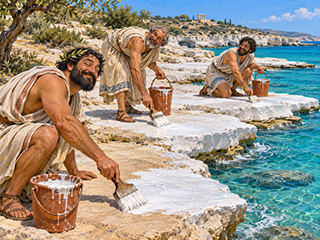 Much of this coastline consists of chalk from the Lefkara Formation. Chalk is a fine-grained type of limestone. It formed from carbonate sediment that collected on an ancient seabed and gradually hardened into rock.
Look for pale bands running across the exposed rock faces. These layers preserve part of that history. At the waterline, meanwhile, waves continue to wear away the chalk. In places, you can see shallow recesses beneath ledges that project over the water.
What does White Sands refer to?
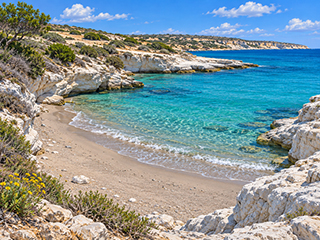 At SancyTours, we use White Sands for a nearby stretch of beach along this coast. On maps and in visitor guides, you’ll also encounter names such as Governor’s Beach and Kalymnos. Those names help distinguish the different parts of the shoreline.
The colour contrast is especially striking at Governor’s Beach. There, white chalk outcrops separate small coves, some with dark grey sand. Nearby, Kalymnos has flatter ground and a longer, narrower strip of sand. If you’re looking for a sandy beach, Kalymnos is a useful name to look for on the map.
What can you see from the shore?
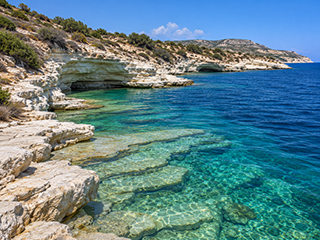 Start with the shape of the coast. Some chalk ledges reach almost flat into the sea, while others curve around small inlets. From a wider viewpoint, those alternating ledges and coves are easier to pick out.
Then look closer at the waterline. You can often see where a pale shelf continues beneath the surface. In contrast, the open sea beyond the shallow turquoise water can appear deep blue.
White Rocks Photo Gallery
 Our gallery brings together wide views of the chalk coast and closer looks at the rock layers.
In the wider frames, you can see how the white ledges divide the shoreline into small coves.
Meanwhile, close-up photos show where the pale chalk meets the turquoise water.
Book Your Private White Rocks and White Sands Tour
 Come with us to explore the chalk coast and spend time by the sea at White Sands. We guide the tour exclusively for you and the people you book with. Along the way, we’ll adapt the pace to suit you, with time to walk, take photos or enjoy the views.
Author: Jürgen Derichs am 17. Nov 2026 06:58, category: Infothek – Nature of Cyprus, comments per feed RSS 2.0, comments closed.